Chicago has hundreds of moving companies. Some are excellent. Some will overcharge you, show up late, damage your furniture, or disappear with a deposit. The difference between the two is not always obvious from a website or a quick search result – but it becomes very obvious on a moving day.
Hollander International Storage & Moving has been operating in Chicago since 1888. In 130-plus years, we have seen every shortcut, every scam, and every red flag the industry produces. Here is how to evaluate a Chicago moving company before you hand over your belongings and your money.
Check Licensing and Insurance First
Every legitimate moving company operating in Illinois should be able to provide two sets of credentials without hesitation.
For moves within Illinois, the company needs an active license from the Illinois Commerce Commission (ILCC). This is the state regulatory body that oversees intrastate movers and sets the rules for estimates, liability, and consumer protections. If a company cannot produce an ILCC number, it is either unlicensed or operating outside the law.
For interstate moves – anything that crosses a state line – the company needs to be registered with the Federal Motor Carrier Safety Administration (FMCSA) and carry a USDOT number. You can verify any company’s registration, insurance status, and complaint history using the FMCSA’s search tool at safer.fmcsa.dot.gov. A reputable company will display its USDOT number on its website, its trucks, and its paperwork. If you ask for it and get a vague answer, move on.
Beyond licensing, ask about valuation coverage. There are two levels: Released Value Protection, which is the minimum required by law and covers your belongings at only 60 cents per pound per article – meaning a 50-pound flat-screen TV would be valued at $30. Then there is Full Value Protection, which requires the mover to repair, replace, or compensate you based on the current market value of damaged or lost items. Any company worth hiring should offer Full Value Protection as an option and explain the difference clearly.
Hollander carries full licensing (ILCC, FMCSA DOT# 77949, MC# 8668) and offers Full Value Protection on every move.
Read Reviews - But Read Them the Right Way
A high star rating matters, but not in isolation. A company with a 4.7 rating from 337 reviews tells a very different story than a company with a 5.0 from 12 reviews. Volume matters because it reflects consistency, not just a handful of lucky jobs.
When you read reviews, do not just look at the star count. Look for patterns across multiple reviews. Do different reviewers mention the crew arriving on time? Do they describe furniture being carefully wrapped? Do they mention the final bill matching the estimate? Do they comment on how the crew handled stairs, tight spaces, or fragile items?
Negative patterns are just as important. If multiple reviews mention surprise charges, damaged items, late arrivals, or crews that rushed through the job, those are not isolated incidents – they are how the company operates.
Cross-reference reviews across multiple platforms. Google is the primary source for most consumers, but also check the Better Business Bureau, Yelp, and industry-specific directories. A company that has strong reviews on one platform and complaints on another may be selectively managing its reputation rather than consistently delivering good service.
Hollander’s 337 Google reviews at 4.7 stars are worth reading in full. The patterns are consistent: punctual crews, careful wrapping, accurate billing, respectful behavior in the home. That consistency across hundreds of moves is the strongest signal of reliability.
Get Written Estimates and Understand the Pricing
Before you book any moving company in Chicago, you need to understand how they charge and what is included. The questions to ask:
What is the hourly rate, and how many crew members does it include? What is the minimum charge? How is travel time billed – from the company’s warehouse to your home, or only for time at your locations? Are there additional charges for stairs, long carries from the door to the truck, or elevator usage? What packing materials are included, and what costs extra? Is the estimate binding (the final price will not exceed the quote) or non-binding (the final price is based on actual time and materials)?
A company that gives you clear, specific answers to all of these questions is worth more than a company that gives you a low headline number with vague terms. The cheapest quote often turns into the most expensive move once the hidden charges are added on moving day.
Get the estimate in writing. If a price, a service, or an inclusion is not written down, it is much harder to hold anyone accountable when the crew is in your home and the clock is running.
For local moves in Chicago, most reputable companies charge by the hour with a crew minimum. For long-distance moves, pricing is typically based on shipment weight and distance. In both cases, a written estimate should clearly state what is and is not included.
Ask About Chicago-Specific Experience
Moving in Chicago is different from moving in a typical suburb. The city has logistics that a company without local experience will not anticipate, and those surprises cost you time and money.
High-rise and condo moves require elevator reservations (often with refundable deposits), certificates of insurance (COIs) naming the building management as an additional insured, restricted move-in and move-out hours, and loading dock or designated parking coordination. A company that does not know to ask about these requirements before moving day will cause delays and potentially force you to reschedule.
Walk-up apartment moves involve narrow stairwells, tight turns at landings, gangway access between buildings, and rear alley loading. A crew that has done hundreds of Chicago walk-up moves handles these buildings with efficient systems – stair-climbing dollies, furniture disassembly protocols, and pre-planned loading sequences. A crew encountering these buildings for the first time will take longer and be more likely to damage walls, banisters, or your belongings.
Moving truck parking on Chicago residential streets requires a temporary “No Parking” permit from the city, with signs posted at least 24 hours before the move. A good Chicago mover will walk you through this process during the estimate. A company unfamiliar with the city will not mention it – and when the truck arrives to find no curb space, you lose time.
Seasonal demand in Chicago peaks between May and September, with the heaviest demand in June, July, and August. During peak season, booking four to six weeks in advance is standard. End-of-month dates and holiday weekends fill up first. A mover with experience in Chicago’s market will tell you this upfront; a company that always has availability during peak season may not have enough demand to stay busy – and that is its own red flag.
Evaluate Their Services and Flexibility
Not every move is the same, and a good moving company should offer the flexibility to match your specific situation. Questions to consider:
Do they offer both full-service packing and self-pack options, or only one? Do they have storage available for short-term and long-term needs – and is it their own facility or a third party? Can they handle specialty items like pianos, fine art, antiques, gun safes, and wine collections, or will those need a separate vendor? Do they offer commercial and office moving in addition to residential? For long-distance moves, are they an agent of a national van line or an independent operator?
A company that can handle your entire move – local or long-distance, packing and storage, residential and commercial, standard and specialty items – under one roof is more likely to deliver a coordinated experience than a company that subcontracts out the parts it cannot handle itself.
Hollander offers local and long-distance moving, residential and commercial service, full-service packing, secure storage at our own facility, and specialty handling for pianos, artwork, antiques, and high-value items – all managed internally. As a United Van Lines agent, we also provide nationwide and international logistics through one of the most recognized networks in the industry.
Red Flags to Walk Away From
Some warning signs should end the conversation immediately:
The company has no physical address or office – just a phone number and a website. A legitimate moving company has a real facility where trucks are parked, equipment is stored, and business is conducted. Hollander’s headquarters are on Pratt Boulevard in Elk Grove Village, and our Chicago office is on Milwaukee Avenue. Both are real locations you can visit.
The company demands a large cash deposit before the move. Reputable movers may require a small deposit to hold a date, but a demand for a large upfront cash payment – especially one that seems to discourage credit card use – is a sign of a fly-by-night operation.
The company will not do an in-home or video survey before giving a quote. Any company that quotes a price without seeing the volume and access conditions of your home is guessing – and that guess almost always works in their favor, not yours.
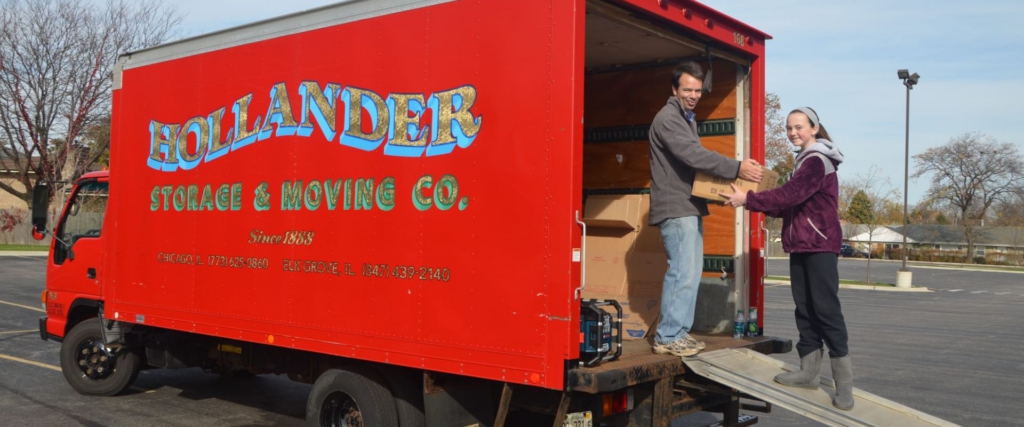
The trucks are unmarked. Licensed movers are required to display their company name and USDOT number on their vehicles. Unmarked trucks are a sign of an unlicensed operation.
There is no written contract. Every move should have a bill of lading that details the services, the pricing, the liability coverage, and the terms. If a company is reluctant to put the agreement in writing, the agreement is not worth having.
Choose a Mover You Can Verify
The right moving company is one you can verify at every level – licensing, insurance, reviews, physical location, written estimates, and clear contracts. Hollander International Storage & Moving has been earning that trust since 1888. We are family-owned, fully licensed (DOT# 77949, MC# 8668), insured with Full Value Protection options, and reviewed by more than 337 customers at a 4.7-star average on Google.
If you are planning a move in Chicago or the surrounding suburbs, request a free estimate or call us at (847) 439-2140. We will walk through your home, give you a clear written quote, and answer every question on this list – because we have nothing to hide.
You can also read what our customers have to say on our reviews page.